Showing posts with label 8/2 Swedish cotton. Show all posts

Saturday, 28 November 2015

Project: Double Weave Baby Blanket


A woman at my office is having a baby shortly, and in what was perhaps an excess of enthusiasm I decided to weave her a cotton baby blanket in that lovely Swedish cotton yarn.  In doubleweave.  Double width.  Because who doesn't love challenges.  And deadlines.  

The result?  A triumph of determination and a testament to my ability to weave all night for three nights straight.  But it got done in time, which is what counts.

The pattern was a straight twill in a selection of rainbow colours with bleached white cotton as the weft.  I set up the loom with 968 ends across 20" on the Louet Jane table loom, with 4 ends in each dent in the reed for 48 epi.  The piece was worked in doubleweave with one end open and the other joined for a fold that created a finished piece that was about double the width on the loom.  
Detail showing the open end and the two layers of cloth
With draw-in, the nominal 40" working width came down to about 37.5" off the loom, and about 50" long (before hemming).  After washing and finishing the completed blanket measured 34" x 40".  

Working doubleweave was much more straightforward than I expected, and I was helped both by Jennifer Moore's excellent book Doubleweave, as well as assistance from the Nerd who had far more experience working doubleweave than I.  

Among the Nerd's more useful advice was a recommendation to work a single row in a contrasting colour every two inches or so, raising a single bottom layer shaft so that the two layers are joined together.  This keeps the two layers roughly together and avoids issues from one layer being higher than the other as the fabric is wound onto the cloth beam, so that both layers are beaten evenly.

Work in progress showing "joining" picks to keep the layers together
I worked in a straight twill, throwing two picks on the top layer, and two picks on the bottom layer, for 8 pattern rows, repeated.


I found it was quite easy to avoid weaving errors (or as I call them, "trademarks") on the visible top layer, but almost impossible on the bottom layer, even with tipping the loom up periodically.  The Nerd tells me that a mirror helps to spot problems, and I will definitely try that approach on my next doubleweave project.

The other major thing I noted is that the ends tended to get compressed along the fold, in a somewhat irregular way, creating a pattern not unlike snakeskin along the fold line.  Not any weaving problems really, just an irregular look.  I am told that adding some thicker "support" ends along the final 4 ends before the fold may help avoid this collapse, and I will definitely try this.  I think avoiding a high-contrast colour that shows the compression is another trick - - I suspect the irregularities would be much harder to see on a plain white-on-white twill, rather than a white on dark purple, where the compression is more obvious.  


After the desired length was woven, I cut the work off the loom and pulled out the securing threads, and then carefully separated the layers to check for any missed picks that caught the layers together.  In a stunning triumph, I had no joined areas, and the entire blanket separated easily once I removed the work from the loom and teased apart the ends that had been tied around the apron rod by the cloth beam.  
Carefully separating the layers to check for adhesions
Finishing was straightforward.  I machine-sewed a zigzag stitch along each end to hold the hem during washing, and then threw the piece into the washer and dryer.  All that was then required was to trim the loose ends and finish the piece with proper hems.  
Finished blanket, folded in half
Finished blanket, unfolded


Project Update: Goose Eye Twill Towels

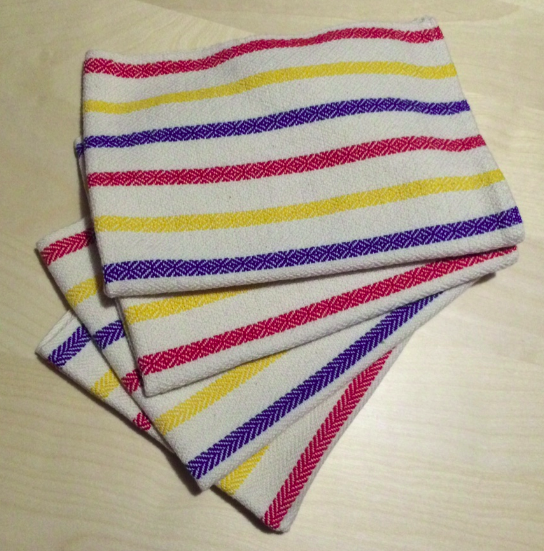
In support of our gallery showing (details in a separate post), I have been weaving my beloved goose-eye twill tea towels in that gorgeous Swedish (Egyptian) cotton on a virtually industrial scale.  After the initial rainbow and blue series, I worked up a second set of rainbow towels, as well as a second set of blue/purple tea towels and a lovely green series. 

The only variations are in the background colour - - natural versus white, depending on the batch (overall I prefer how the bleached white makes the accent colours pop), and length - - recent sets have finished up around 24" versus about 19"-20" for earlier sets woven to the pattern. 

So here for your viewing pleasure are some photos from these recent towel sets.  Enjoy!


Saturday, 17 October 2015

Project: Goose-eye twill tea towel series (blue variation)


Having finished the goose-eye twill pattern in the cheerful rainbow range I wanted to work up a set of tea towels in a single colour range - in this case, blues and violets. 
The setup and pattern were exactly the same as for the rainbow towels.  I measured out 4 yards of warp in the 6 chosen accent colours and a bleached white background.  The colours went from light to dark across the reed and reflected back from dark to light at the midline. 

The weaving was quick and easy once again.  Well, as "quick" and "easy" as handweaving on a table loom can ever be.  Which is not all that quick or easy in the global scheme of things, but pretty quick and easy as far as handweaving is concerned.

I was able to measure out my warp using the built in warping board on my trusty Kromski Harp loom (as is my custom) and then transfered my chains of measured warp to my apron rod by myself with no difficulty.  Arranging the warp threads in the raddle and rolling the warp onto the back beam was similarly quick and easy.  It tool only a single (full!) day to measure my warp from cones to set up the loom and get everything ready to weave, which is pretty quick as these things go.


After completing weaving four tea towels each in the goose-eye twill I cut the towels apart and then ironed the hems in preparation for machine hemming.  After hemming it was simplicity itself to throw the hemmed towels into the washer and dryer to finish them prior to trimming off all the loose threads. 

I really really love the classic simplicity of this pattern as well as the wonderful softness of the finished towels.  The colours in this "blue period" series will be perfect for a certain Nerd's mother (these are her favourite colours) but I can see many people liking this colour selection.


I have a real desire to work a similar set of goose-eye twill in a lovely green range, and have ordered the yarn for this next project.  For now I may measure out another rainbow towel, but this one using the natural cotton and a herringbone twill for a change of pace.  We shall see. 


Monday, 12 October 2015

Project: Goose-eye twill tea towel series (rainbow variation)


I enjoyed working the Glimakra tea towel kit so much that I ordered some additional cones of the Swedish cotton yarn and decided to work up the pattern again using colours of my choice.

For this series I chose 8/2 cotton in 6 colours of the rainbow - red, orange, yellow, green, blue and purple.  The pattern for this particular towel reflects so the pattern mirrors after the purple stripe, progressing back to a red stripe at the outer right hand side of the towel.

I particularly liked how quick and easy it was to set up the loom using the kit last time.  There were comparatively few snarls and tangles requiring cleaning as I wound the warp onto my back beam, and the yarn held its tension well throughout the project.  If anything, however, working from scratch to measure out the warp from cones made it even quicker to set up the loom - - fewer tangles in my chains meant faster overall setup.

I used my trusty Kromski Harp loom flipped upside down as my warping board to measure out 4 yards of warp as follows:
12 ends bleached white
12 ends red
24 ends bleached white
12 ends orange
24 ends bleached white
12 ends yellow
24 ends bleached white
12 ends green
24 ends bleached white
12 ends blue
24 ends bleached white
12 ends purple
12 ends bleached white
[the pattern now repeats, reversed, starting with the purple, then blue, green, yellow, orange, and finishing with the red, for 432 ends in total]
The tie up was simple enough across 12 ends as shown below:


The goose-eye twill required a repeating series of 12 rows as follows:

Row 1 - shafts 1 and 2
Row 2 - shafts 1 and 4
Row 3 - shafts 3 and 4
Row 4 - shafts 2 and 3
Row 5 - shafts 1 and 2
Row 6 - shafts 1 and 4
Row 7 - shafts 2 and 3
Row 8 - shafts 3 and 4
Row 9 - shafts 1 and 4
Row 10 - shafts 1 and 2
Row 11 - shafts 2 and 3
Row 12 - shafts 3 and 4

4 yards of warp is perfect to weave up 4 towel in the goose-eye twill where each towel measures 24" with 1" of space left for a hem at each end (26" in total per towel).  There was ample warp left on the loom so that I did not feel like I had to work right up to the apron rod, but not so much wastage that I felt like cutting down the warp for the next time I work these towels.

I spent about a week on these towels, from start to finish, and they were a real pleasure to work just like the last set.  I think I will make a series of these goose-eye twill towels to give out at Christmas as gifts, customizing the colours for certain people.  Me, I love the rainbow, but it's not everyone's cup of tea.

Finishing was just as easy as last time - simply cutting the towels apart and running a simple hem and throwing them in directly in the washer and dryer.  After washing and trimming off loose ends the goose-eye twill pattern popped even more than when the work was on the loom, and the finished towels are very soft with a lovely drape to them.

I have already begun work on the next set of towels in this goose-eye twill series, the ones I call the "blue period" because they are in shades of blues and lilacs that the Nerd's mother loves.  I also have a mind to do the same but in shades of green for the Patriarch, as his kitchen is all shades of green accents.


Sunday, 4 October 2015

Project: Glimakra twill tea towel kit


Finished twill towels
I first began weaving around mid-October last year.  When I started I had a rigid heddle loom and not a lot of knowledge about what would work well on that piece of equipment. 

I picked up some random "weaving cotton" along with the loom as well as a whole bunch of kits with the intention of using them to help teach me to weave.  I was a little intimidated however, because the kits called for a more advanced loom than I possessed at the time. 

Now we own several looms, including an 8-shaft Louet Jane table loom (aka the "Superloom") [my favourite multi-shaft loom of our bunch] and an 8-shaft (previously 4-shaft) Ashford table loom (aka the "Muscle Loom 2000").    These multi-shaft table looms are perfect for working these kits including the Glimakra "My First Towels" kit. 
Winding up the warp

Technically this kit is inaccurately named - - these were not my first tea towels, nor were they my first kit.  But these kits are great and convenient, with pre-measured and ordered chains that only need to be put on the loom.  Super convenient to set up and get you started weaving quickly - - the perfect project to inaugurate the weaveteria in the new house. 
Ready to start weaving
The kit has enough 8/2 Swedish cotton to work 4 tea towels of approximately 24" each.  I chose to work up a pair of herringbone twill and a pair of goose-eye twill tea towels. 
Herringbone and goose-eye twill on the loom

The towels worked up super quick and easy on 4 shafts.  The heddles were threaded in a 12-end pattern that worked for both the herringbone and goose-eye without changing the tie up.  Treadling for the herringbone was in a repeating 4-row pattern, while treadling for the goose-eye was in a repeating 12-row pattern.
Web fresh off the loom ready for finishing

I frankly enjoyed working the goose-eye towels better than the herringbone because I did not need to worry about floating selveges on the goose-eye twill, while the herringbone was a bit fussy on the left-hand edge, which slowed me down.  All in all, though, both patterns were a delight to weave and look fantastic. 


We finished the towels with a plain hem in zigzag stitch on the machine and then threw the towels into the washer and dryer - - any tea towel that I want to give to someone else had better be durable; they are functional rather than works of art after all. 
Finished herringbone twill
Finished goose-eye twill

I enjoyed this project so much that I picked up more 8/2 Swedish cotton from Vävstuga.  This time I  got a set of colours in a rainbow for a new set of goose-eye twill towels.  The new warp is measured out and ready to wind onto the back beam. 
Ready to wind the warp onto the back beam