|
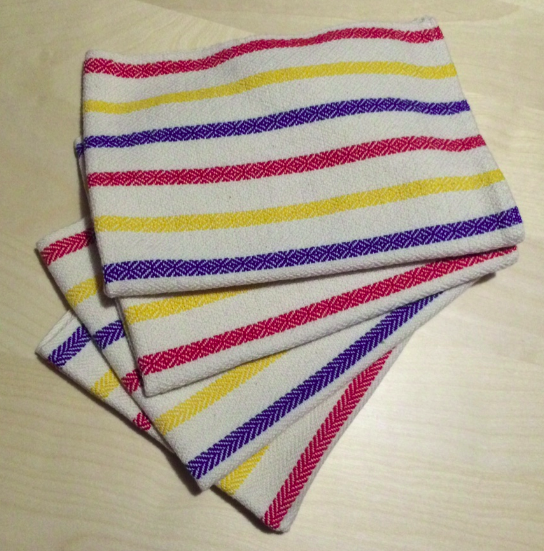
| All finished! |
When I first began weaving I picked up a bunch of tea towel kits on the rationale that they would be straightforward to make and they would teach me valuable techniques. Over time I was distracted with my other weaving projects, usually shawls, which are perfectly suited to my
Kromski Harp rigid heddle loom. Because tea towel kits are generally worked in fine cotton or cotton blends that are prone to tangle, they are a bear to work on my Kromski Harp, and as a result I now have a backlog of tea towel kits begging for my attention.
With the purchase of the Superloom (aka the
Louet Jane 8-shaft table loom) and the Muscle Loom 2000 (aka the
Ashford 4-shaft table loom), at long last I had looms that could make quick work of these projects.
This week's project was the
Glimakra Elin tea towel kit in cottolin (60% cotton/40% linen blend). This kit has everything you need to start and has the advantage of a warp that was already measured sufficient for 4 towels, cut and chained, so all I had to do was choose my threading and begin warping my loom.
For this kit I used the Louet Jane 8-shaft loom but only used shafts 1-4 (the Ashford was occupied) tied up for the straight twill and broken twill. I chose to work 2 towels in each pattern. The kit comes with a couple of small quills of accent colours so that one could add a stripe to one towel, but the amount was so little that I stayed with the natural bleached white weft for all 4 tea towels.

Warping up the Louet was a pleasure, and it took no time at all to set up the loom. Even threading the heddles was a treat after having worked with the rigid heddle for so long. I picked up a
Schacht auto reed hook in my travels and tried it out for the first time with this kit - - what a pleasure! I have now used the auto reed hook on a couple of projects and I have to say that I still have no idea how the thing works - - some form of magic, apparently. But work it does and the auto reed hook makes short work of sleying any table loom reed.
Weaving was similarly a treat. The Louet has a very smooth and balanced action that made it easy for me to maintain a nice even beat for the twill and broken twill for each towel.
 |
| Detail showing broken twill (top), tabby for hem (middle), and straight twill (bottom) |
Finishing up was just as straightforward. All I had to do was cut the work off the loom, cut the individual towels apart, and then hem each towel on the sewing machine (admittedly my least favourite part of the entire process).
 |
| Fresh off the loom (left) and cut into individual towels (right) |
 |
| Hemming in progress |
After hemming I threw the towels into the washer and dryer, and then ironed them so that they would look nice for photographs. The towels were each originally woven to about 16" x 24" on the loom, and after washing and drying the finished towels measure about 15 5/8" x 22 5/8" - - perfect for kitchen use. The project used up only about half of an 8.8 oz cone of bleached cottolin for the weft, and whatever was used for 4 yards x 432 ends for the warp.
 |
| Twill towels |
 |
| Broken twill towels |
I really enjoyed working on these towels, and the kit was perfect. Everything I needed from materials to clear, concise instructions were provided, and the finished result looks wonderful. Now that I have had the time to practice with the material, however, I would go straight to the source and pick up the cottolin by the cone rather than use a kit - - it is more cost-effective, and the colour selection is much wider than the choices provided in Glimakra's kits.