Showing posts with label window pane. Show all posts

Saturday, 4 March 2017

Project: Doubleweave Windpwpane Shawl

Woven: January - February 2016
Fiber: 8/2 tencel
Reed/Sett: 8-dent/32 epi

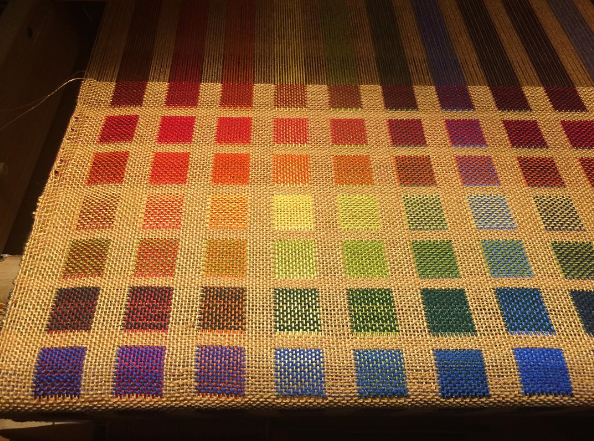
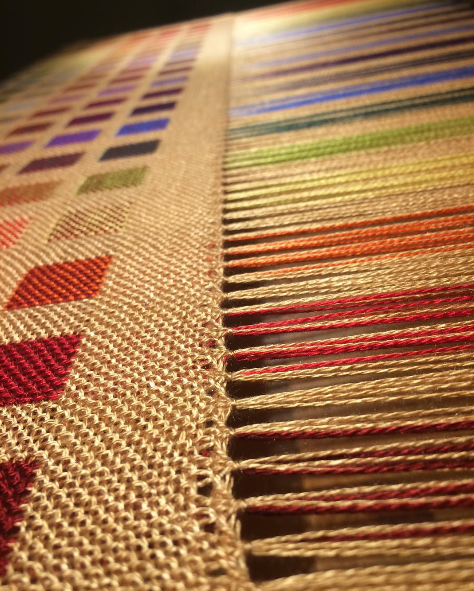
This project was a further development on the doubleweave baby blanket, and one that finally delivered on the weaving porn on the front of Jennifer Moore's excellent Doubleweave book.  My plan was to use her table runner pattern and weave a shawl in 8/2 tencel. 

Before getting started I wove some samples to work on the technique.  Using 4 ends per slot in the reed (2 per layer) I started on the top with a 12-dent reed.  The finished product was so dense that it was almost rigid, which although fine for a very structured garment, was not ideal for a shawl.  The middle, long sample was woven with a 10-dent reed, and the bottom, widest sample was woven using the 8-dent reed.  For a shawl I thought the 8-dent sleyed at 4 ends per slot for 32 epi was the way to go.


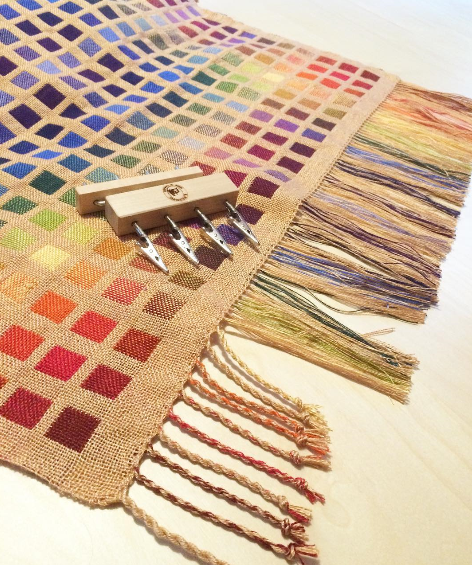
For my colours I chose a lustrous bronze as my base, with rainbow colours as my contrast blocks.  The plan was to mirror the pattern throughout the shawl. 
 
 
I used a temple to maintain my selvedges because draw-in without the temple causes by warp threads to snap.  With the temple, the weaving was very straightforward on the 8-shaft Louet Jane table loom.  The shawl was finished with twisted tassels, and after wet finishing (hand wash and dry flat) the finished shawl (exclusive of tassels) measured 23.5" x 72.5". 
 
For more information check out my website at deftlyweft.com or my instagram page at @the_meglg and @DeftlyWeft.


Sunday, 8 February 2015

Project: Windowpane Lace Inspired Wool Shawl/Throw

I asked one of friends the other day what her favourite colours were with a mind to weaving something for her.  "Ivory or beige or sort of a light grey" was her response.  I suspect she was thinking in terms of neutrals for a bed throw rather than a pop of colour for her wardrobe because her personality is definitely anything but beige. 

Armed with this description, I thought that when working with a more neutral wool there were more opportunities to play with texture that in some of my previous projects.  In an earlier sampler project I had quite liked the look of 3/1 Windowpane floats, which simply involve using a pickup stick threaded 1 up and 1 down across the loom, worked in 6 simple pattern rows:

Row 1: heddle up
Row 2: heddle neutral with pickup stick;
Row 3: heddle up
Row 4: heddle down
Row 5: heddle up with pickup stick forward;
Row 6: heddle down

It's just as easy as that.  The net result is a very pretty, delicate looking fabric suitable for a shawl or a bed throw as desired.  Or the world's least practical pocket square - - I don't try and tell people how to use my projects any more (!).  It's a rectangle, I know that.  After that, it's all on the recipient what they make of it. 

For this project I chose some W4 Worsted Weight 100% wool from Shelridge Yarns that I picked up at the Purple Purl, a local yarn store on Queen Street East by Carlaw.  While I prefer Romni Wools (on Queen Street West by Bathurst) for its ridiculously huge selection, I do like the Purple Purl because it is much easier to shop - - everything is visible and it's much less of a treasure hunt through narrow aisles overstuffed with exotic wools. 

My only complaint relating to this project is that somehow a single skein of Shelridge DK weight 100% wool was shelved in the same cubby, likely by mistake (since the Purple Purl organizes their yarns by weight) - - with the identical colour and virtually identical label - - and of course I snapped it up while picking out the wool for this project.  I only discovered the errant skein after I had wound it onto my warping board (fortunately, it was the first skein I chose).  Much cursing was heard when I discovered that mistake, I'll tell you.  On the good side, even though I had 1 fewer skein than I had intended, I was able to weave up the length I wanted with the W4 wool with 1 entire bobbin to spare.  Whew!

My setup was very straightforward, using only a single 10-dent heddle on my Kromski Harp loom along with a pickup stick.  Once again my little hand-held row counter was a lifesaver, as it was very easy to lose count, especially when I was distracted.   And we all know how easily I am distracted (!).

This wool warped up quickly and wove generally well, but it was prone to static and had a tendency to stick a bit in my heddle as a result.  Overall the wool was just that little bit fussy to work, but it wove up so nicely and washed so well I would happily use it again - - albeit after closely checking the labels next time!

I guarantee that I have woven in my trademark errors into the pattern, just so that people know it's my work.  But the pattern looks so nice overall it's easy to overlook the occasional strangeness.  And who's to say that the deviations are not part of the pattern, right?  Not me.

From start to finish this project took only 2 weeks.  I would have been a bit quicker (because the pattern really is quite fast to weave) but we had a guest from overseas staying in our living room for the past week and I have to confess that I felt a bit strange whipping out the loom and weaving in front of him.  Nothing to do with our guest - he was and is a lovely man - but rather from my own desire not to be a completely selfish hostess and entirely focused on my own project.  Plus, with the sofa bed in play the number of available seats in our living room was decreased by 50%, so I felt a bit self conscious about monopolizing one of our two remaining soft chairs with my loom.


Fresh off the loom the work measured 25 1/4" x 78 1/2", off of a 100" warp across 150 ends on my 10-dent heddle - - not quite the full width of my 32" Kromski loom (probably about 29" or so across the heddle).  After washing the finished work was about 23 1/4" x 75" - - a nice length for a shawl (or bedrunner or monster table runner or family-style placemat...).


As with my other shawls/bed runners/etc. I have finished the piece with a tiny "M" bead (with thanks again to Padge). 


I am quite pleased with the finished project, and really like how the texture turned out. 


Tuesday, 30 December 2014

Sampler: Rigid Heddle Pick Up Stick Patterns

Because tabby weave is all very well and good but a little - well - boring, I am learning new texture techniques for my Kromski Harp rigid heddle loom.

Over the holidays I picked up a fantastic book, Textures and Patterns for the Rigid Heddle Loom by Betty Linn Davenport, which is just chock-full of interesting patterns and techniques.  The copy I ordered from Amazon shipped in a day or two, and came complete with a signature by Betty Linn Davenport herself.  Her handwriting is just as lovely as you would expect from someone with a name like "Betty Linn Davenport".

I started small, with some simple weft floats.  For these patterns I inserted my pick up stick 1 up x 1 down (repeated), 2 up x 2 down (repeated) and 3 up x 3 down (repeated), working from right to left across the row.  Looking up from the bottom, the number of pattern rows in each series increased.  In each case these the pattern rows were worked with the heddle in the neutral position.

Weft Floats front (L) and back (R)

Moving on to warp floats, I did not change the position of my pick up stick.  This time the pattern row was woven with the heddle in the up position.  As with the weft floats, the patterns change from a single pattern row in a series to longer floats covering multiple rows.

Warp Floats front (L) and back (R)
Warp and weft floats are symmetrical, in that if you float your weft on one side, you get a floating warp on the reverse, and vice-versa.  So no, I did not simply repeat the first set of photos and reverse the order, although it certainly looks like I could have.

Now came the time for some lace weaves.  I started with a simple 3/1 lace for which the pick up stick was set 1 up x 1 down all the way across the row.  This pattern, like the weft float it is based on, used the pick up stick in the neutral position for the pattern row, with 1 pattern row (row 2) and 3 plain weave rows (rows 1, 3, and 4).

3/1 Lace front (L) and back (R)
I liked the texture of the 3/1 lace, both on the front and the back of the piece, although the pattern was very subtle on the 3/2 mercerized cotton that I was using for this sampler.

The 5/1 lace is very similar in concept to the 3/1 lace, but in this case the pick up stick was set up as 1 up x 2 down across the row, and there were 2 pattern rows (rows 2 and 4) and 4 plain weave rows (rows 1, 3, 5, and 6).  I didn't like the look of this lace quite as much as the 3/1 lace, which has a certain symmetry I found lacking in the 5/1 lace.

5/1 Lace front (L) and back (R)
I also did some colour studies in my sampler such as an weft float in contrasting yarn, loom controlled inlay, and a couple of colour variations, but the purple I used as my contrast colour is very difficult to see (some would say impossible to see) against the bright royal blue of my background, so I am not including photos of these studies here.  Suffice it to say that I did these techniques, and while I liked the effect on the front of the work (although it would have been more impressive with a thicker contrast yarn), I did not like the big floats of contrast colour on the reverse side of the work.  These effects got a big "meh" from me, but they are likely very useful to know for the right work (perhaps for something lined so that the messy underside is hidden).

Another lovely pattern is the Double Huck Spot Weave created with 5/1 weft floats and 2 pick up sticks used in sequence.  The first pick up stick is inserted 4 up x 2 down across the row.  The pattern is then worked with a series of 6 rows, with rows 2 and 4 being pattern rows with the pick up stick in the neutral position, and rows 1, 3, 5, and 6 being plain weave.  Once this series is completed the second pick up stick is inserted 1 up (2 down x 4 up, repeated across the row), and the pattern of rows repeats, with the second pick up stick being used in the pattern rows just as the first was.
5/1 Weft Floats (Double Huck Spot Weave) front (L) and back (R)
I can see how someone would be tempted to set up the second pick up stick pattern using string heddles because it must be an almighty pain in the butt to have to remove and re-insert the second pick up stick every 6 pattern rows.  It was fun for my little sampler, but I can see how the novelty would wear off really quickly if weaving a larger piece.  Which is a pity, really, because it creates a lovely effect.

Another of my favourite textures, the Window Pane laces, are created by warp and weft floats.  The first is a 3/1 Window Pane, which uses a single pick up stick set 1 up x 1 down across the row.  Unlike the plain 3/1 lace, which used the same pick up stick setup but only had a single pattern row with the heddle in the neutral position, the 3/1 Window Pane has 2 pattern rows in the series (rows 2 and 5), the second of which was woven with the heddle in the up position. The remaining rows (rows 1, 3, 4, and 6) are plain weave.  This pattern creates a wonderful symmetrical effect that is virtually indistinguishable from the front to the back, and is very easy to weave.

3/1 Floats (Window Pane) front (L) and back (R)
The 5/1 Window Pane also produces a very interesting effect, and although it is not symmetrical from front to back like the 3/1 Window Pane, the back is pretty in its own way.  This pattern is woven, like the 5/1 lace, with a single pick up stick set 1 up x 2 down, repeated across the row.  For this pattern there are 3 pattern rows (rows 2, 5, and 7) with the latter two pattern rows being woven with the heddle in the up position.  The remaining rows (rows 1, 3, 4, 6, and 8) are plain weave.

5/1 Floats (Window Pane) front (L) and back (R)
I also played with my new tassel twister because hey, why not?  It worked great, and I can see how it would produce a lovely effect on longer fringes (rather than the stumpy little fringe-ettes I had in my sampler).


So all in all it was a fruitful evening spent learning many interesting new textures.  I already have a few I would like to incorporate into my next throw, if not all the way through, certainly near the edges for interest.