Showing posts with label houndstooth. Show all posts

Saturday, 30 May 2015

Project: Houndstooth Shawl in Peruvian Wool


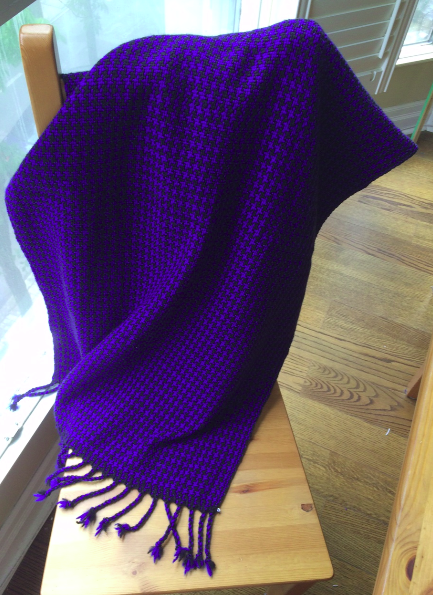
My most recent project is another one of my beloved houndstooth shawls.  This one is in a bold blue and black using Cascade 220 100% Peruvian Highland wool from Camilla Valley Farm.  The colours were Black #8555 and Blue Velvet #7818 (trust me, it is a rich royal blue, no matter how purple it is in the below photograph!).  I know I do a lot of houndstooth, but it's only because I love the pattern so much - - it's a true classic that looks good year after year. 
 
For this project I went through 4 x 100g skeins of each colour using my 8-dent heddle on my trusty Kromski Harp rigid heddle loom.


I measured out about 116" warp across 240 ends, alternating 2 ends of each colour across the reed, with the intention of working a standard 2 x 2 houndstooth. 

This wool is somewhat stretchy so I got a lot of mileage out of each skein, and it was very easy to work having comparatively few tangles when warping the loom, especially when compared to some of the "grippier" yarns I have worked with (like unmercerized cotton).

For finishing I hemstitched in bundles of 4 ends and then made 30 tassels of 2 x 4 ends each.  The alternating warp yarn created a really neat variegated look for each tassel.


Because houndstooth is a straight tabby weave the pattern actually weaves up pretty quickly, especially on an 8-dent heddle - - although probably not quite as quickly as shown in the video below!


The finished project measured 25 1/4" x 78 1/2" before washing and 24 1/2" x 77" after washing. 

Fresh off the loom before washing and finishing
Finished shawl after washing and finishing
I really enjoyed this project, and the wool was a pleasure to work with. 


I know my camera and the lighting does magical things with the colour of this shawl, but trust me that this is a royal blue and black houndstooth shawl (not purple and black, although that would look awesome too).  The above photo of the shawl over the chair back is probably the closest to the true colour of the photos in this set. 

Sunday, 12 April 2015

Project: Cream and Mustard Yellow Houndstooth Shawl

In case it was not yet obvious, I just love houndstooth as a shawl pattern.  The beautiful interplay of the balanced warp and weft just work for me in ways that other patterns do not.  So it should come as no surprise to see me working up another houndstooth shawl or bed throw or pocket square (as the recipient is so inclined to call the end product).  It's a rectangle, that's all I know.  A BIG rectangle.  Perhaps it could be used as the roof on a pillow fort. 

This time I used a fine sock yarn from Spud & Chloe in "popcorn" and "bumblebee", aka ivory and light mustard yellow.  The yarn itself is an 80/20 blend of merino superwash wool and silk, and has a lovely soft feel.  As has been my recent pattern I purchased the yarn at the Purple Purl on Queen Street East in Toronto.  They give a 10% discount to guild members, and although I am sure they intended for the discount to apply to knitters, weavers' guilds also get the discount and my membership in the Ontario Handweavers & Spinners guild totally counts.  Which is good, because I buy yarn in bulk now that I am weaving, rather than a ball at a time like I used to when I knit.

For this project I used my trusty Kromski Harp rigid heddle loom set up with a single 10-dent heddle (in the back position to give me more working space without having to advance the warp as frequently).  I warped up the loom in my preferred 2 x 2 pattern, alternating the ivory and mustard across about 28" of the reed, for 100" of total warp.  This delivered a finished dimension of 24" x 93 1/2" (excluding fringe) before washing, and a final dimension of 23 1/2" x 92" after washing. 

There were no real surprises with this project, which wove up relatively quickly.  I warped up the loom on March 21 and finished the project today (three weeks later) after bringing it with me to Columbus OH on a brief family visit weekend last weekend, and ignoring the work for long stretches of time when I was out of town on business (it has been a busy few weeks for me).  I do love the portability of the Kromski Harp that gives me the option of bringing a project-in-progress with me on short trips, and I took advantage of that functionality on this project. 

I chose the mustard because it was a colour requested by a friend of mine, but I wanted to lighten it using the ivory to keep the finished work from being too bold.  Plus, if I made a mistake when selecting the wool and went too yellow or too mustard with the main colour, the ivory would attenuate the visual impact.  As a further plus, it just looks pretty, so there's that.  It also makes for a subtle houndstooth pattern, which adds to the visual interest.

I am going on another family visit in a couple of weeks and have another shawl/bedrunner project I would like to start and finish, as well as a couple of tea towels to make as hostess gifts for my relatives.  It will be a busy few weeks of weaving for yours truly!
Now I must swift the yarn for my next project.  As soon as I can find my swift, that is.  And probably as soon as I clean up the debris from this latest weaving project - - shouldn't start a new project with the vestiges of the old cluttering up my workspace!


Monday, 29 December 2014

Project: Red and Black Houndstooth Shawl in Merino

Before the holidays we had dinner with some friends and one of them told me her favourite colours were red and black.  Well, that just screamed out "houndstooth" to me.  I love that colour combination and I was pretty sure I could weave something nice. 

For this project I chose a wonderfully soft merino wool from Malabrigo in Ravelry Red and Black that I picked up at Romni Wools on Queen Street West in Toronto.  Each skein contained about 210 yards, so I picked up 5 skeins of each colour (for safety) to ensure I could set up a 100+ inch warp across 300 ends and not run out of wool. 

Rather than using my 12-dent heddle (as I did for the lilac and black shawl), I went with the 10-dent heddle after seeing that the yarn could comfortably work on even the 8-dent heddle.  I was pleased with how easy it was to sley the reed using the 10-dent heddle (much easier than the 12-dent).  The wool was also very easy to weave using the 10-dent heddle, not rubbing overmuch on the reed and throwing off only a slight amount of lint. 

This wool is very stretchy however, so I had some concerns about how evenly it would weave up, but it turned out the weave was fairly balanced and it appears my concerns were misplaced. 

This is your typical 2 x 2 houndstooth pattern - - 2 ends of each colour alternating across the reed with 2 picks of each colour for the entire length of the warp. 

I was hoping for a shawl that measured more than 70" long by 24" - 27", and the finished shawl after washing and trimming ended up being 72" x 26" - - right in the sweet spot.


Santa brought me a fringe twister for Christmas so my next big work will have twisted tassels.  The ends for this project were left in a simple fringe that untwisted after washing into a fluffy end treatment that is kind of visually interesting, if nothing else. 

I hope my friend likes her shawl!


Monday, 15 December 2014

Project: Houndstooth Shawl in Merino Wool

It is no secret that I love houndstooth - - it's a beautiful pattern that is deceptively simple to make.  And if there's anything that I love more than the deceptively simple, I don't know what it is. 

For this project I chose Kollage Happiness fingering weight 100% superwash merino wool in black and lilac.  Each skein is 100g / 450 yards.  I estimated that I would require about 1050 yards of each colour, so for safety I picked up 3 skeins of each colour intending to try for a finished work that was 28" wide x 70+" long (I wasn't too fussy about the length so long as it was more than 70") using a 12-dent heddle. 

My challenges on this project came early.  My first 12-dent heddle was broken adjacent to one of the holes, something I discovered only as I was about to begin threading the holes in my heddle.  This required me to manually transfer the entire width of my warp to my second 12-dent heddle.  Many profanities were heard that afternoon, I will tell you.  Thank you weaving gods for my double-heddle setup, so that I had a backup heddle ready to go while the Nerd repaired the defective heddle. 

My next challenge was in threading the holes in my heddle.  I think that the 12-dent heddle was actually the right call for this particular wool, however it is very challenging threading my 12-dent heddle with the hook provided with my loom.  Because the hook itself barely fits through the heddle, let alone with wool, threading each hole was a challenge of wills requiring much to-ing and fro-ing, and I had more than half a dozen ends simply disintegrate as I was pulling them through a hole.  This left me with several extremely short ends amidst many longer ends, and I probably lost more than 2-3" of warp in evening everything out.


I also had 1 end come through the hole only 2/3 of the way, leaving a twist of fiber on the back end of the heddle, something I did not notice until I had been weaving for a few inches.  More cursing.  At the end of the day, however, this did not pose an insurmountable problem as I simply worked the tag end of the wool towards the back of the loom as I advanced the warp to prevent it from ratcheting up the tension on the one warp thread as it got caught on the heddle.  I can't even tell where it was in the finished piece, which is nice. 

Although I think the 12-dent heddle was the right call for this fingering weight wool it was a close thing, and I found the wool had a real tendency to stick together making it difficult to get a clean shed.  This was remedied by the judicious use of pick up sticks to help me manually force sticky warp threads apart, ensuring that my weaving errors were kept, if not to a minimum, to a dull roar. 

I didn't do anything too fancy with this shawl, just a plain hemstitch at each end with a moderate fringe, but the simplicity works for this pattern, I think.  I did add a little ceramic "M" at one corner as a signature (just in case the usual errors I included in the piece weren't enough to identify me!).

Right off the loom the finished piece was 26" x 74", and after washing and hanging to dry the shawl ended up being 24 1/2" x 72".  I was pretty happy with the length (although I do prefer longer shawls as a rule and would probably go even longer next time) and even though I had more draw-in and shrinkage than I expected on the width, I think I could happily have gone a little narrower on the width, so this was not a bad result. 


Like the baby llama, merino is another wool that sheds like a mother, but feels so soft in the hand that all is quickly forgiven.  So long as there is a lint roller close at hand, anyways!


I love how this piece turned out and am keeping it for myself.  I have rationalized that it's OK to be selfish some of the time.  Besides, my next project is a return to industrial scale tea towel fabrication as preparation for Christmas.  Those will all be given away, so everything balances out. 

Thursday, 23 October 2014

Work 2 - Houndstooth Check Table Runner

Work 1 - - the primitive childlike weaving of incredible unevenness and unintentional loops - - went much better than expected, actually.  Along the way we discovered that part of my issues with keeping an even tension in my work were because our pawls were on the ratchets backwards so the gears kept slipping.  Good thing to discover on a piece of scrap work.

For work #2 I wanted to try a simple houndstooth check using a 2 x 2 pattern (2 warp threads of each colour and 2 picks of each colour, alternating one after the other).   I also wanted to try getting the tension right this time, so I really took my time setting up my warp.  I switched to a 10-dent heddle because the 8-dent heddle was very very airy using my 3/2 mercerized cotton yarn - - I kept the fiber the same as in work #1 because I liked the colours and thought that the red and garnet combination would still have an adequate contrast for the houndstooth. 

I used the single warping peg again this time to help set up the warp, because I thought that trying to play with tension, colour, and a completely new warping method was one innovation too many. 

I am almost certain that I set up my back end of my warp in the most labour intensive way possible, tying off knots on each end of each colour, all the way along the warp assist dowel.  This took literally hours.  I started on Saturday evening and finished Sunday around lunch time.  At first it just felt like it took forever, and then I started to get into a rhythm and the time seemed to pass faster.  Don't get me wrong - - it still took hours, I just didn't mind it as much.


With the pawls on facing the right way and using warp sticks I was able to maintain a nice tight tension on my warp while I wound the warp onto the back beam.  The next step was figuring out how to tie off my warp threads onto the front warp assist dowel.  The first time I set up my loom I used a giant loose bow because I couldn't figure out the knot that would permit me to adjust the tension. 

This time I watched more Tim Horchler videos on warping my loom and I called in an expert: the Nerd.  He was able to figure out the first knot, and he showed it to me.  It was really head smacking time - - it was so easy, a simple overhand knot!  D'oh!

These half knots permitted me to adjust the tension on my warp across the groups of warp threads, ensuring a much more even tension across the whole width of my warp.  It will come as a shock to no one when I tell you that these little knots have a much lower profile than big loopy bows (!), so they caused less bumpiness when I began winding the work onto the front beam.

Speaking of the bumpiness of winding over the knots on the front beam, this time I actually used warp sticks to help hold the finished weave up over the knots as I wound the fabric around the beam, and it helped keep my work much flatter in the working portion. 
With the warp nicely set up it was time to begin weaving, and this is where the fun began.  I am sure all practiced weavers will nod their heads when I say that it took me as long to set up the warp as it took me to weave the entire work. 

I loved the way that the houndstooth pattern wove up.  Once again the boat shuttles and preloaded bobbins work a treat - - it was so easy to swap out empty bobbins for preloaded bobbins as required. 


I started weaving just after lunch and finished weaving the length of the warp and knotting up the fringes by 10.30 pm.  I set up my warp initially across 12" of the heddle, 6" on either side of center.  Coming off the loom the finished work was about 11.5" wide x 45.25".  After washing the work shrunk up by about 8%, so that the new dimensions were 10.25" x 41.5".   

I wasn't trying to achieve a specific width or length because this was still a test project so it was a bit of a surprise to see the dimensions both when the work came off the loom and after washing.  I am beginning to see why we always need to add inches on the warp and weft to accommodate shrinkage and tightening of the woven fabric.

I am more convinced than ever than my next test work needs to be warped using the warping board rather than a single warping peg, to create a longer work.  I also found this work was still a bit airy so I might use a 12-dent heddle the next time I use the mercerized cotton yarn, or I may change to a different fiber. 

All in all I was extremely pleased with the result for work #2.  For another largely test project I thought it went pretty well.  My selvedges were pretty straight and even, the tension regular, and the pattern showed up nicely.  I wished the finished work had been a little bit longer, but that is the limitation of direct warping the loom.