Monday, 12 October 2015

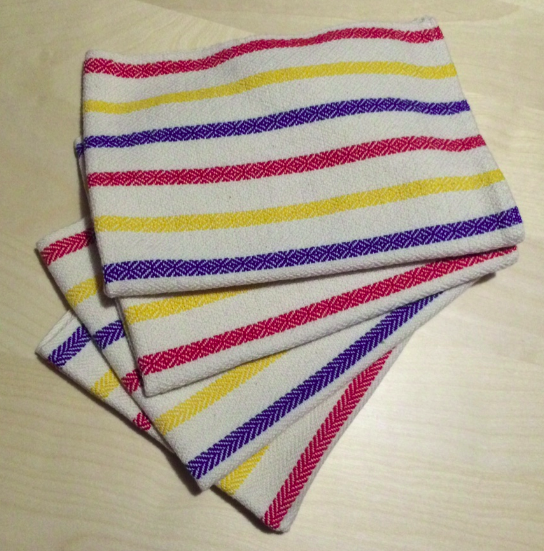
Project: Goose-eye twill tea towel series (rainbow variation)


I enjoyed working the Glimakra tea towel kit so much that I ordered some additional cones of the Swedish cotton yarn and decided to work up the pattern again using colours of my choice.

For this series I chose 8/2 cotton in 6 colours of the rainbow - red, orange, yellow, green, blue and purple.  The pattern for this particular towel reflects so the pattern mirrors after the purple stripe, progressing back to a red stripe at the outer right hand side of the towel.

I particularly liked how quick and easy it was to set up the loom using the kit last time.  There were comparatively few snarls and tangles requiring cleaning as I wound the warp onto my back beam, and the yarn held its tension well throughout the project.  If anything, however, working from scratch to measure out the warp from cones made it even quicker to set up the loom - - fewer tangles in my chains meant faster overall setup.

I used my trusty Kromski Harp loom flipped upside down as my warping board to measure out 4 yards of warp as follows:
12 ends bleached white
12 ends red
24 ends bleached white
12 ends orange
24 ends bleached white
12 ends yellow
24 ends bleached white
12 ends green
24 ends bleached white
12 ends blue
24 ends bleached white
12 ends purple
12 ends bleached white
[the pattern now repeats, reversed, starting with the purple, then blue, green, yellow, orange, and finishing with the red, for 432 ends in total]
The tie up was simple enough across 12 ends as shown below:


The goose-eye twill required a repeating series of 12 rows as follows:

Row 1 - shafts 1 and 2
Row 2 - shafts 1 and 4
Row 3 - shafts 3 and 4
Row 4 - shafts 2 and 3
Row 5 - shafts 1 and 2
Row 6 - shafts 1 and 4
Row 7 - shafts 2 and 3
Row 8 - shafts 3 and 4
Row 9 - shafts 1 and 4
Row 10 - shafts 1 and 2
Row 11 - shafts 2 and 3
Row 12 - shafts 3 and 4

4 yards of warp is perfect to weave up 4 towel in the goose-eye twill where each towel measures 24" with 1" of space left for a hem at each end (26" in total per towel).  There was ample warp left on the loom so that I did not feel like I had to work right up to the apron rod, but not so much wastage that I felt like cutting down the warp for the next time I work these towels.

I spent about a week on these towels, from start to finish, and they were a real pleasure to work just like the last set.  I think I will make a series of these goose-eye twill towels to give out at Christmas as gifts, customizing the colours for certain people.  Me, I love the rainbow, but it's not everyone's cup of tea.

Finishing was just as easy as last time - simply cutting the towels apart and running a simple hem and throwing them in directly in the washer and dryer.  After washing and trimming off loose ends the goose-eye twill pattern popped even more than when the work was on the loom, and the finished towels are very soft with a lovely drape to them.

I have already begun work on the next set of towels in this goose-eye twill series, the ones I call the "blue period" because they are in shades of blues and lilacs that the Nerd's mother loves.  I also have a mind to do the same but in shades of green for the Patriarch, as his kitchen is all shades of green accents.


Sunday, 4 October 2015

Project: Glimakra twill tea towel kit


Finished twill towels
I first began weaving around mid-October last year.  When I started I had a rigid heddle loom and not a lot of knowledge about what would work well on that piece of equipment. 

I picked up some random "weaving cotton" along with the loom as well as a whole bunch of kits with the intention of using them to help teach me to weave.  I was a little intimidated however, because the kits called for a more advanced loom than I possessed at the time. 

Now we own several looms, including an 8-shaft Louet Jane table loom (aka the "Superloom") [my favourite multi-shaft loom of our bunch] and an 8-shaft (previously 4-shaft) Ashford table loom (aka the "Muscle Loom 2000").    These multi-shaft table looms are perfect for working these kits including the Glimakra "My First Towels" kit
Winding up the warp

Technically this kit is inaccurately named - - these were not my first tea towels, nor were they my first kit.  But these kits are great and convenient, with pre-measured and ordered chains that only need to be put on the loom.  Super convenient to set up and get you started weaving quickly - - the perfect project to inaugurate the weaveteria in the new house. 
Ready to start weaving
The kit has enough 8/2 Swedish cotton to work 4 tea towels of approximately 24" each.  I chose to work up a pair of herringbone twill and a pair of goose-eye twill tea towels. 
Herringbone and goose-eye twill on the loom

The towels worked up super quick and easy on 4 shafts.  The heddles were threaded in a 12-end pattern that worked for both the herringbone and goose-eye without changing the tie up.  Treadling for the herringbone was in a repeating 4-row pattern, while treadling for the goose-eye was in a repeating 12-row pattern.
Web fresh off the loom ready for finishing

I frankly enjoyed working the goose-eye towels better than the herringbone because I did not need to worry about floating selveges on the goose-eye twill, while the herringbone was a bit fussy on the left-hand edge, which slowed me down.  All in all, though, both patterns were a delight to weave and look fantastic. 


We finished the towels with a plain hem in zigzag stitch on the machine and then threw the towels into the washer and dryer - - any tea towel that I want to give to someone else had better be durable; they are functional rather than works of art after all. 
Finished herringbone twill
Finished goose-eye twill

I enjoyed this project so much that I picked up more 8/2 Swedish cotton from Vävstuga.  This time I  got a set of colours in a rainbow for a new set of goose-eye twill towels.  The new warp is measured out and ready to wind onto the back beam. 
Ready to wind the warp onto the back beam


Sunday, 5 July 2015

Project: Twill Tea Towel Kit in Cottolin


All finished!
When I first began weaving I picked up a bunch of tea towel kits on the rationale that they would be straightforward to make and they would teach me valuable techniques.  Over time I was distracted with my other weaving projects, usually shawls, which are perfectly suited to my Kromski Harp rigid heddle loom.  Because tea towel kits are generally worked in fine cotton or cotton blends that are prone to tangle, they are a bear to work on my Kromski Harp, and as a result I now have a backlog of tea towel kits begging for my attention.

With the purchase of the Superloom (aka the Louet Jane 8-shaft table loom) and the Muscle Loom 2000 (aka the Ashford 4-shaft table loom), at long last I had looms that could make quick work of these projects.

This week's project was the Glimakra Elin tea towel kit in cottolin (60% cotton/40% linen blend).  This kit has everything you need to start and has the advantage of a warp that was already measured sufficient for 4 towels, cut and chained, so all I had to do was choose my threading and begin warping my loom.

For this kit I used the Louet Jane 8-shaft loom but only used shafts 1-4 (the Ashford was occupied) tied up for the straight twill and broken twill.  I chose to work 2 towels in each pattern.  The kit comes with a couple of small quills of accent colours so that one could add a stripe to one towel, but the amount was so little that I stayed with the natural bleached white weft for all 4 tea towels.

Warping up the Louet was a pleasure, and it took no time at all to set up the loom.  Even threading the heddles was a treat after having worked with the rigid heddle for so long.  I picked up a Schacht auto reed hook in my travels and tried it out for the first time with this kit - - what a pleasure!  I have now used the auto reed hook on a couple of projects and I have to say that I still have no idea how the thing works - - some form of magic, apparently.  But work it does and the auto reed hook makes short work of sleying any table loom reed.

Weaving was similarly a treat.  The Louet has a very smooth and balanced action that made it easy for me to maintain a nice even beat for the twill and broken twill for each towel.

Detail showing broken twill (top), tabby for hem (middle), and straight twill (bottom)
Finishing up was just as straightforward.  All I had to do was cut the work off the loom, cut the individual towels apart, and then hem each towel on the sewing machine (admittedly my least favourite part of the entire process). 
Fresh off the loom (left) and cut into individual towels (right)
Hemming in progress

After hemming I threw the towels into the washer and dryer, and then ironed them so that they would look nice for photographs.  The towels were each originally woven to about 16" x 24" on the loom, and after washing and drying the finished towels measure about 15 5/8" x 22 5/8" - - perfect for kitchen use.  The project used up only about half of an 8.8 oz cone of bleached cottolin for the weft, and whatever was used for 4 yards x 432 ends for the warp.


Twill towels
Broken twill towels
I really enjoyed working on these towels, and the kit was perfect.  Everything I needed from materials to clear, concise instructions were provided, and the finished result looks wonderful.  Now that I have had the time to practice with the material, however, I would go straight to the source and pick up the cottolin by the cone rather than use a kit - - it is more cost-effective, and the colour selection is much wider than the choices provided in Glimakra's kits. 


Saturday, 30 May 2015

Project: Houndstooth Shawl in Peruvian Wool


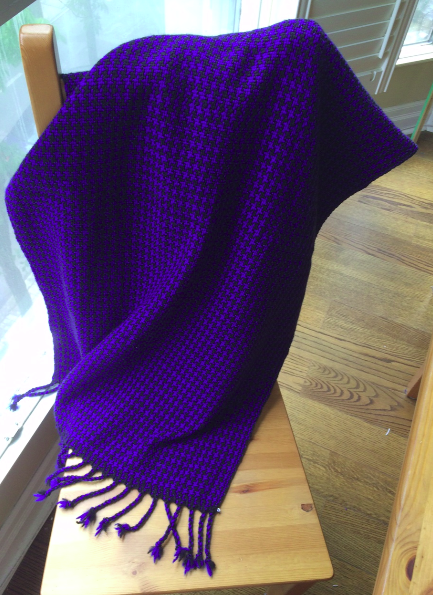
My most recent project is another one of my beloved houndstooth shawls.  This one is in a bold blue and black using Cascade 220 100% Peruvian Highland wool from Camilla Valley Farm.  The colours were Black #8555 and Blue Velvet #7818 (trust me, it is a rich royal blue, no matter how purple it is in the below photograph!).  I know I do a lot of houndstooth, but it's only because I love the pattern so much - - it's a true classic that looks good year after year. 
 
For this project I went through 4 x 100g skeins of each colour using my 8-dent heddle on my trusty Kromski Harp rigid heddle loom.


I measured out about 116" warp across 240 ends, alternating 2 ends of each colour across the reed, with the intention of working a standard 2 x 2 houndstooth. 

This wool is somewhat stretchy so I got a lot of mileage out of each skein, and it was very easy to work having comparatively few tangles when warping the loom, especially when compared to some of the "grippier" yarns I have worked with (like unmercerized cotton).

For finishing I hemstitched in bundles of 4 ends and then made 30 tassels of 2 x 4 ends each.  The alternating warp yarn created a really neat variegated look for each tassel.


Because houndstooth is a straight tabby weave the pattern actually weaves up pretty quickly, especially on an 8-dent heddle - - although probably not quite as quickly as shown in the video below!


The finished project measured 25 1/4" x 78 1/2" before washing and 24 1/2" x 77" after washing. 

Fresh off the loom before washing and finishing
Finished shawl after washing and finishing
I really enjoyed this project, and the wool was a pleasure to work with. 


I know my camera and the lighting does magical things with the colour of this shawl, but trust me that this is a royal blue and black houndstooth shawl (not purple and black, although that would look awesome too).  The above photo of the shawl over the chair back is probably the closest to the true colour of the photos in this set. 

Project: 3/1 Lace Shawl in Merino Wool


It has been a while since I have posted, and I have been remiss because I have actually been checking projects off my list - - I have just been too busy weaving to blog.

For this project, I wanted to do some textured weaving for someone dear to my heart.  I was told that her favourite colour was light yellow, and I thought that a light colour like this would be the perfect choice to showcase a 3/1 weft float lace pattern worked using my trusty Kromski Harp rigid heddle loom and a single pickup stick (lovingly handmade by the Nerd). 

For this project I went back to my faithful standby the Purple Purl wool emporium for some lovely Tanis hand-dyed DK weight superwash merino wool in a bright Buttercup yellow.  The weight was perfect for the 10-dent heddle.  Fresh off the loom the shawl was 23 1/2" x 74 1/2" [excluding fringe] and after washing it measured 22" x 73". 

I used Betty Lynn Davenport's fabulous book Textures and Patterns for the Rigid Heddle Loom as the guide because I simply love the look of the 3/1 weft float lace - - it's especially nice after washing, when the texture really comes into its own (see the bottom photo, below). 


I warped up the loom in the usual way with about 110" warp across 240 ends.  For finishing I hemstitched in groups of 4 ends which I then twisted into tassels of 2 x 4 ends each x 30 tassels across each hem. 


Tassels in progress...
The finished shawl is a warm butter yellow colour, very soft to the touch and warm, thanks to the wool.  I am very pleased with this project and how it turned out, and hope that the recipient likes it as much as I do.
Finished shawl before washing and trimming woven-in ends
Finished shawl after washing and trimming

Finished shawl after washing and trimming